
Gregg Treinish didn’t start out as an outdoor enthusiast, but found solace and purpose in nature during his youth. After years of enjoying the outdoors, he was left feeling a need to give something back to the world.
He found fulfillment by using his passion for outdoor adventures to gather critical data that researchers need for conservation and scientific research. That’s how his nonprofit organization, Adventure Scientists, came to be.
“We harness the collective power of the tens of thousands of people that are outside every day — who love the outdoors and have a passion for exploring the outdoors — and we give them real scientific missions that they can do while they’re out there that benefit conservation,” Treinish says.
Those missions have helped create the largest ever data set on microplastics (at the time), aid research into antibiotic resistance, and collect critical data on threatened species. All of these impacts, Treinish says, derive from the shared sense of purpose among volunteers who feel their actions truly matter and make a difference in the world, an ingredient he argues is necessary to bring about positive change.
“It is so fulfilling to watch somebody who felt helpless against climate change, the microplastics issue, biodiversity loss — any one of these massive problems we’re facing — [and] give them a way [to feel] they matter and that they can have a positive impact. And it changes their lives. It changes the way they see the world,” Treinish says.
His team is currently training volunteers to help map the entire biodiversity of California, scout for orcas off Oregon, track the distribution of whitebark pine in the Pacific Northwest, and monitor coral reefs in Mexico, Costa Rica, Honduras and Colombia. See all current and past projects at the Adventure Scientists site, here.
The Mongabay Newscast is available on all major podcast platforms, including Apple and Spotify, and previous episodes are also accessible at our website’s podcast page.
Please take a minute to let us know what you think of our podcast, here.
Mike DiGirolamo is a host & associate producer for Mongabay based in Sydney. He co-hosts and engineers the Mongabay Newscast. Find him on LinkedIn and Bluesky.
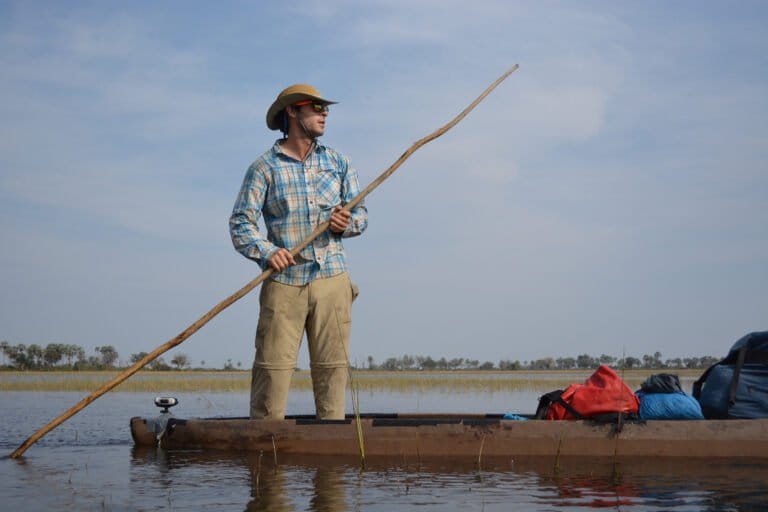
Banner image: Gregg Treinish in Botswana’s Okavango Delta. Image courtesy of Shah Selbe.
Note:
Mongabay has a grant to report on California’s biodiversity from the California Institute of Biodiversity (CIB), which also funds a variety of institutions engaged in researching biodiversity in California. CIB also provides funding to Adventure Scientists. Mongabay maintains complete editorial independence over stories about grantees of CIB, which means CIB does not have the right to assign, edit, or review Mongabay’s reports prior to publication.
Related reading:
Transcript
Notice: Transcripts are machine and human generated and lightly edited for accuracy. They may contain errors.Gregg Treinish: But anyway, I was doing these jobs, and it was amazing what I got to do, and had such rich experiences in the outdoors, but I was seeing that I was doing that and actually having an impact, and actually making a difference, especially for animals that were so understudied, like the lynx and wolverine. And so I started talking about that with friends. I started sharing those stories. And I was fortunate enough: after the Andes trip, I got a National Geographic Adventure of the Year award, so I had some access to people who I really admired, and started talking about that feeling with them. And one by one, it was reiterated over and over again that so many people share that feeling, that we feel so helpless in the face of these massive challenges in the world, and that it’s really hard to understand how we as individuals can have a real impact and how we can really be involved. And I was doing that. I was feeling that every day. And once I started sharing that, people said, I want to do that. People said, how do I get involved? How do I do that? And so it almost created itself that way. It was just my personal experiences, which then led to more and more people saying, yeah, include me in this. And we did.
Mike DiGirolamo: Welcome to the Mongabay Newscast. I’m your co-host, Mike DiGirolamo, bringing you weekly conversations with experts, authors, scientists, and activists working on the front lines of conservation, shining a light on some of the most pressing issues facing our planet, and holding people in power to account. This podcast is edited on Gadigal Land. Today on the newscast we speak with Gregg Treinish, the founder and executive director of Adventure Scientists, an organization dedicated to collecting environmental data across the globe, which has mobilized 10,000 volunteer hikers, mountaineers, and adventurers to gather critical data researchers need for conservation and environmental science. Treinish has gained significant media attention for his world-shaking data collection efforts. He’s collaborated on collection projects that have a direct impact on things like antibiotic resistance research, illegal deforestation, microplastics, and threatened species. Treinish and his team, at the time of one project, collected the world’s largest data set on microplastics, and now they’re involved in mapping the entire biodiversity of the state of California. But Treinish did not start out as an outdoor enthusiast, and he describes his background to me in this conversation as that of an at-risk youth who found solace and purpose in nature. After years of soul searching in the wilderness, this journey led Treinish to start Adventure Scientists. He describes to me how the organization works, its impact, and the projects it is working on in the future. I have to say, I was left inspired and genuinely hopeful from this conversation. It is, arguably, a statement on the power of mission-driven science and what humans can accomplish when they feel their skills are being put toward the common good. Gregg Treinish, welcome to the Mongabay Newscast. It’s a pleasure to have you with us.
Gregg: Yeah, thanks so much. Happy to be here.
Mike: And you are the founder and executive director of Adventure Scientists. Can you describe to our listeners what Adventure Scientists does?
Gregg: Yeah, absolutely. So we harness the collective power of the tens of thousands, or hundreds of thousands, of people that are outside every day, who love the outdoors and have a passion for exploring the outdoors. And we give them real scientific missions that they can do while they’re out there that benefit conservation.
Mike: And we’re going to get into the nitty gritty of that in a little bit, but you mentioned that before you started Adventure Scientists, you had been spending years in the wilderness. Have you always been someone who explores the outdoors? What brought you to it?
Gregg: Yeah, growing up I actually wasn’t that exposed to the outdoors. I would be in my backyard catching fireflies and chasing deer in the backyard, but I was not on camping trips with my family. I was not really exposed to mountains and nature the way that I live today, and I’m exposing my kids to today. What it first was for me was a backpacking trip that I went on when I was 16 years old, up in British Columbia. And I think my parents were looking for some hope, any hope, that they could find, and somebody must have suggested that I go on a backpacking trip. But I was labeled an at-risk youth. I was kicked out of a high school. I was really struggling as a teenager. And when I went on this backpacking trip in the mountains of British Columbia, in Garibaldi Provincial Park, I felt this connection to the place I was, and I felt this deep connection to myself in a way that I hadn’t before that. And I just fell in love. I fell in love with being in the mountains, and being in the wilderness, and struggling through those ecosystems, and pushing myself. And I’ve been hooked ever since.
Mike: That’s an incredible story, Greg. And so you, how many years were you spending in the wilderness before you started Adventure Scientists? Because you said that a sense of guilt, that you weren’t giving back, is what drove you to start the organization. So how long were you spending in the wild, and when was that moment when you finally decided, I think I want to give something like this a go?
Gregg: Yeah. So after that trip when I was 16, I pretty quickly, when I was 18, moved out to Colorado to go to school at Boulder. And then I had the most amazing time up there. Three days a week I would go up and ski, and I’d go to class on the other days, but three days a week during the week, and then the weekend. So I just got deeper and deeper. I was a raft guide and a ski instructor after school, moved up to Breckenridge and then Leadville, Colorado, and started working. Eventually went and hiked the Appalachian Trail, which took six months and eight days. And then after that became a wilderness therapy guide. And then I went on a two-year, 22-month expedition down the length of the Andes Mountains. So my friend Dea and I became the first to walk the length of the Andes, through the mountains, to trek the length of the Andes without relying on roads, and staying as close to the spine as we could. And yeah, I really haven’t stopped since then. My jobs after that experience were: I had started to really develop an interest in ecology and biology. So I got jobs tracking lynx and wolverines and grizzly bears. And my job tracking wolverines and lynx in particular was amazing. I would take my boss’s truck and park it at a trailhead, and get on a snowmobile and go up as far as I could into the mountains, and then park the snowmobile, and then get on my skis, and then go and follow wolverine tracks sometimes for days, just following them and putting together the behaviors of what they were doing and collecting DNA samples along the way. And so I started using more and more of my outdoor abilities and outdoor experience to make a difference and have a positive impact. It was first on the Appalachian Trail, actually, that I had this moment where it’s about halfway through, and been walking for three months, and I was questioning in my head, leading up to this moment, what’s it all for? What’s the purpose of this? And I fell down for the 17th time that day. It was raining, it had been raining for days on end, just pretty miserable conditions. And I picked up a big rock and chucked it at a tree, and just started sobbing, because I was feeling so without a purpose, without a mission, and being really selfish for being out there doing something that just didn’t benefit anybody in the world. And I struggled with it. I did finish the trail, and vowed that I would dedicate my life to purpose and to figure out how to combine an outdoor passion with a need to give back and do something positive for the world. And in the Andes, I thought that was going to be learning about sustainability and learning from people who had lived for millennia in the Andes sustainably, and come back and share those lessons. I did that. I absolutely gave lectures after we got back and talked about it, but I didn’t really find my purpose until I had been through the wilderness therapy, and been through the sustainability, and really landed on wildlife ecology as what I meant to do.
Mike: Thank you for sharing that, Greg. That’s such a deeply personal and incredibly illuminating story. When did it click in your head for you that collecting environmental information was the way to go with this?
Gregg: Yeah. So it’s those experiences and the jobs that I had, but also I started combining long-distance expedition travel with biology and with the sciences. Once I, so when I was in the Andes, I’m nearing the end, and we’d been walking for almost two years, and I’m thinking to myself, alright, what’s next? What am I going to do with my life? And at the time it was, more than anything, what I wanted to do was figure out how I can help protect lions in Africa. And I reached out to a professor here at Montana State who does that, works with the local Maasai people, and studies predator-prey interactions and people interactions with predator-prey groups, and helps, just like he does here in the Greater Yellowstone ecosystem, helps with the Maasai land and Maasai people who are ranchers, the same way they are here in Montana, who are dealing with lions and dealing with leopards and other carnivores there. So before I ever made it to Africa to study with Scott, I ended up getting this job tracking lynx and wolverines, and that was amazing. And then I got a job with owls, where I get to go and, at seven o’clock at night I’d get to a trailhead and I’d walk until two or three AM, hooting for owls along the way. I got really good at an owl hoot. And then I got a job on the Fort Peck Reservoir on the Missouri River studying sturgeon, which is such a cool, I’ve never even been into that fish. I don’t hunt, I don’t fish. But this animal is like a dinosaur. It’s 130 years old, are the majority of the pallid sturgeon living there because none of the recruits since they built a dam in the 1930s have been able to grow up and prosper. And so we were studying where the zero-velocity line, where they fall out of the water column was. But anyway, I was doing these jobs, and it was amazing what I got to do, and had such rich experiences in the outdoors, but I was seeing that I was doing that and actually having an impact, and actually making a difference, especially for animals that were so understudied, like the lynx and wolverine. And so I started talking about that with friends. I started sharing those stories. And I was fortunate enough: after the Andes trip, I got a National Geographic Adventure of the Year award, so I had some access to people who I really admired, and started talking about that feeling with them. And one by one, it was reiterated over and over again that so many people share that feeling, that we feel so helpless in the face of these massive challenges in the world, and that it’s really hard to understand how we as individuals can have a real impact and how we can really be involved. And I was doing that. I was feeling that every day. And once I started sharing that, people said, I want to do that. People said, how do I get involved? How do I do that? And so it almost created itself that way. It was just my personal experiences, which then led to more and more people saying, yeah, include me in this. And we did. So we set up these training sessions for lynx and wolverine tracking that my boss at the time, a guy named Steve Gehman, who’s an incredible tracker, an incredible wildlife ecologist, he’s the one who hired me to do what I still think is one of the best jobs I ever had. And we started inviting the public, and we had a hundred people show up on a Saturday to learn about lynx and wolverine ecology, and learn about how they could help with sightings so that they would report a wolverine, a suspected wolverine track, and I would go then follow up, and I’d go and do my thing, and collect the DNA from it. And so that was an early experience I had, not even at Adventure Scientists, that showed me that this was a real thing.
Mike: Wow. And when did you and your team start to get tangible feedback from the wider conservation community or scientists? Like when did you start to see these results really help out the scientific community that you were trying to reach?
Gregg: Yeah. So I actually, before I even started Adventure Scientists, I started doing these biological expeditions. And so what I would do is I’d approach a group like the Greater Yellowstone Coalition, the LYNX, or the Craighead Institute. The Craighead family is a world-famous conservation family, especially here in the Greater Yellowstone ecosystem. And I approached them and I said, hey, here’s who I am. I’ve done these expeditions. I want to do an expedition that really helps you advance your mission. I didn’t know what that response was going to be at first, but right away they seized onto this. And one of these expeditions, what we did is we created a protocol of what it would be like to put myself in the brain of a grizzly bear or wolverine, and move across the landscape using a decision-making tree that the Craigheads and that the Greater Yellowstone Coalition helped me create. And I just documented every fence line. And what the decision-making they would do was so we could ground-validate their least-cost path analysis. Now listen, I don’t think this was the breakthrough they were looking for. I don’t think this was the one moment that changed their careers. But it was helpful, and I felt really good doing it, and it felt valuable. So I carried that from that expedition in particular. I remember distinctly sitting with, again, with Dea, my hiking partner, at lunch. We were having Chinese food here in Bozeman, and I said, man, this was such a great experience. What if I started an organization that could get other people to go and do this? And that was in November of 2010. By January, I quit my job and Googled “how do you start a nonprofit?” And in March of that first year, The New York Times came and covered one of those wolverine trackings that we were doing, and I was doing it now under the name of Adventure Scientists and partnering with Steve rather than doing it under Steve’s umbrella. And then a few months went by, and in May of that first year we had two world-class climbers, Willie and Damien Benegas, who I had met at the Outdoor Retailer Show in Salt Lake City, tell me, hey, we heard about what you’re doing. They heard about it from Conrad Anker, I’m sure, who was one of my first board members, world-class mountaineer that was in Meru, and so many different films now that you all have heard about. They approached me and said, hey, we think we saw this plant life up on Mount Everest. Should we go get it? What do we do with it? And I said, let me get back to you. And I found Rusty Rodriguez from the University of Washington and the USGS, and I found Tim McDermott here at Montana State University, and I partnered them together, and we went and collected the highest known plant life on Earth up at 21,268 feet. And it turns out there were five fungi living symbiotically with the moss that we collected up near Camp Two on Mount Everest, and those fungi make it possible to increase crop yields without the need for synthetic fertilizers. So that feedback started to come right away. We made that massive discovery up on Everest, got it back in The New York Times, so now twice we’re in The New York Times right away. We started getting calls from other researchers and other scientists who thought, hey, if they could go to Mount Everest, maybe they could go to the Tobacco Root Mountains for me. Maybe they could go other places around the globe. And it just cascaded from there where, yeah, the feedback was almost instant because what we were offering and what we were providing, the scientific and conservation community really hadn’t seen before.
Mike: Greg, that is such a remarkable trajectory. It’s hard to overstate the enormity of that, and the impact of that Everest expedition. And there’s so much you’ve done since then. But we’re going to fast-forward really quick to talk about what you’re doing now, which is helping map the entire biodiversity of the state of California, which you did speak with our CEO about. Again, that’s a massive undertaking, but we should at least talk about it a little bit. Can you describe this effort in brief for our audience?
Gregg: Yeah, absolutely. And first I want to acknowledge all of our partners. What I do is I take their brilliant ideas and their amazing stories, and we help accelerate and amplify their ability to succeed. So on Everest, that’s Rusty Rodriguez, right? That is his brilliance, that knew that there was a chance we were going to find these fungi up there. With this project in California, this is Dan Cayan. He’s the brains behind this. This is his initiative, not mine. It actually started way back under Jerry Brown, where they recognized that there was a really big need to map and categorize the biodiversity of California, all the way from the charismatic species we all love, like mountain lions, or at least some of us love, like mountain lions and coyotes, and the things that make their way into folklore, all the way down through the bacteria that are living in the soils, and that make that area of the world unique. And we were asked to help with particularly the soil sampling, the bacteria, and the insect sampling. Now there are other initiatives underway to do intertidal work, to categorize fish and birds and other things across the state that mostly academic researchers and some other groups are working on. But yeah, we brought a scale I think is really difficult to replicate, by empowering hundreds of volunteers across the state, who we trained how to collect the data. We trained them how to collect insect samples. We trained them how to collect soil samples, which then are sent to labs. And on the soil sampling, we use eDNA, environmental DNA, which is this incredible technology, been around for more than 20 years, but it’s just now becoming cheap and effective enough to really use for a purpose like this, where you can actually take a soil sample and look at not only the species that are in that soil sample, but other ones that have moved through that area. It’s amazing technology, which makes it possible to do something like this. So yeah, we visited more than 3,000 sites across the state for Dan and his team, and for the Stillwater Sciences team as well. Dan’s at the California Institute of Biodiversity, and we partnered with them and provided this accelerant, this amplification, that they just couldn’t otherwise do.
Mike: I am so excited to see what comes of this initiative, and it is really remarkable. If folks are interested in learning more, you can see the link in the show notes from the Q&A that Greg has conducted with our CEO, Rhett Butler. But right now, Greg, you have, to my knowledge, three open projects on your website, and they are: searching for killer whales, monitoring coral reefs, and tracking whitebark pine. But first, can you tell me what monitoring coral reefs entails? Does this build on the data that you collected from the closed project that you had on the Allen Coral Atlas?
Gregg: Yeah, great question. This is a little bit different. This was a partnership. So I’m standing in line in the cafeteria at National Geographic’s headquarters sometime just before COVID, and the woman I’m standing next to is Dr. Paula Rodriguez from the University of Guadalajara, another National Geographic Explorer. And as we do in those circles, I said, what do you do? And heard all about her amazing coral work, and how she works with governments to help improve, and minimize, the impacts of tourism on these reefs. And then I told her what I did and her face lit up, because she really struggles to cover this massive area of Mexico’s coastline. And so we immediately formed a partnership and got this up and running. Maybe it took a few months, but we got this up and running where we helped her recruit volunteers who could be trained to go out and supplement her work, again, accelerating and amplifying her brilliance. We did that for two or three years. And then the next phase of this was: other people would benefit from this too. So how can we expand this? And so now we’re working in Honduras, Colombia, Costa Rica, and Mexico. I actually just dove with Paula two weeks ago over Thanksgiving. I happened to be in Mexico and got the chance to dive with her for this project. But now we have four different entities across those four different countries. And in each case, with every project we do, there’s always an end use in mind. We’re not collecting data for data’s sake. We are doing this for conservation. And so in this case, we’re looking at the impacts of tourism and increasing storms on these reefs, and what measures can be implemented to protect these reefs, to give them a fighting chance in the face of these growing storms and increasing pressures. In the case of the California biodiversity, this is part of 30 by 30. The initiative is to protect 30% of land and sea by the year 2030. And by finding out where the most unique biodiversity is, it helps prioritize which areas need to be protected. And so in each case, there’s this through line: if we collect these data, then this conservation action becomes possible. And so in the Mexico coral reef project, expanded to Latin America, not only are we collecting one of the first unified data sets across these four countries, across Latin America’s coral reefs, we’re now also empowering these local researchers to work with their governments and with their managers, to make sure that these reefs stay protected. So that’s that one. I’m super excited about it.
Mike: Hello listeners, and thanks for tuning in. As the year winds down, we encourage you to take a look back at the 44-episode catalog we’ve published this year and let us know your feedback. If you have any thoughts, feel free to share them in our podcast survey available in the show notes of this episode. We’re going to take a break for a little while for the holiday season, but we’ll be back again in January with more news and inspiration from Nature’s Frontline. Yeah, that is definitely exciting. And obviously coral reefs are greatly under threat, so this is an incredibly important project. And so you’re searching for killer whales also, and they get a lot of press lately for attacking boats, but what’s the scoop on the data that you’re trying to collect here? Where will volunteers be going, and what will this aid?
Gregg: Yeah, so there are massive data gaps on the Oregon coast, believe it or not. So we know a ton about this resident killer whale pod up in the Puget Sound area and up in Washington, so there’s a really great, robust monitoring network there, and even in Northern California. The same whale pod makes its way down there and are pretty well studied, but nobody’s really documented, partially because of Oregon’s remoteness and the difficulty of access to the coast, what happens to these whales there, what behaviors they have, what they’re doing there. And so we were asked by our amazing partners at Oregon Shores, as well as the Oregon Department of Fish and Wildlife, to come and help by activating our army to go out and collect presence-absence data, behavioral data, and as many photos as possible, which will help. We can track individual animals through photos now because of AI and all kinds of different tools we’ve got. You can look at the scarring on their body, and you can look at the different patterns on their fluke that show you which individual you’re dealing with. So we’ve got sea kayakers out there. We’ve got mountain bikers out along the coast, and hikers along the, there’s a path that goes the whole length of the Oregon coast. And the more remote, the better. People are out there on overnight backpacks and people are out there on day hikes as well, but they’re looking for and spotting for these. And the power of this is awesome. It’s pretty rare that you get to see a killer whale on the Oregon coast. That’s not where they typically hang out. But for 45 of the last 48 days, we’ve had people out looking for these, and that’s such a huge benefit to these researchers who just don’t have those resources and don’t have that ability to get out there otherwise. So yeah, the volunteers are out there trained how to look for these and what information to record. They start a transect and then record for some period of time, and then they stop after that and record all that. And even that negative data is super helpful, to tell us they weren’t in this stretch of coastline during that period of time.
Mike: I have to say, Greg, I’m really struck, and filled with a lot of positivity and hope, by the gap that you’re filling for researchers, as you just mentioned, who don’t have either the time or the resources to get out and collect this data. It’s really inspiring to see. I just wanted to make that comment. It just popped into my head. But also, in the Pacific Northwest, you’re tracking whitebark pine. You’re trying to collect data on this threatened tree species, correct?
Gregg: Yeah, that’s right. Whitebark pine are an amazing species. First of all, just these old gnarled trees that live up on the most extreme environments across high mountains, particularly in the Greater Yellowstone ecosystem, and then out in the Cascades and Olympics and the mountains of Washington and Oregon, and well into Canada and up to Alaska as well. And they are these cold-obligate species that love these extreme environments. But they also produce a nut, a pine nut, that is super rich in protein and fat, and is a really key grizzly bear food source, is a really key food source for squirrels, and then the Clark’s nutcracker, which is a bird species that’s up there, also rely on these. And there’s this incredible, mutualistic relationship between the tree, the bears, the squirrels, the Clark’s nutcracker, and then all the cascading impacts that has across the forest ecosystem. So because of that, it’s what’s called a keystone species. Just as we were all growing up and went to the science museum and pulled out the keystone from the top of an arch and the whole arch collapsed, that’s what this species represents to the forest. It’s a really important species. And its mortality in recent years has increased and increased. Some estimates are that it’s well over 80% mortality, and the reason for that is that there is a fungus that has gotten into it, pine blister rust, and that weakens the immune system of the tree and then allows beetles to get in there and kill these trees. So what we’re looking for is the trees that have been less affected by both that fungus and by the beetles. We’re looking for the ones that are potentially resilient to these infestations so that we can take their genetics and breed them into new trees. I say “breed them” and “genetics,” and sometimes that can sound scary, but we’re talking about taking the seeds of the resilient trees and planting them in nurseries primarily, that are being run by the Forest Service and others, and then we replant them. And the idea is that if you can find the ones that are less impacted by these infestations, you can preserve this keystone species.
Mike: Incredible. And I hope that one works out for the best. If you can indulge me for a minute, there’s just a couple more I want to talk about. You had a couple of projects, I think they’re completed now. One was the Mongolia wolverine expedition, and another is an antibiotic resistance project. And these are both really interesting in their own ways. But I wanted to start with the antibiotic resistance one, because I understand that’s gotten a lot of attention. So can you tell us about this project? What did it accomplish? What was the impact of it?
Gregg: Yeah, absolutely. Again, the brilliant partner we had here is Dr. Mike Gilmore, and his colleague Ashley Earl, who was at the Broad Institute. Mike Gilmore is at Harvard. He’s currently the head of microbiology at Harvard. And they asked us if we could collect animal poops, scats, from all around the world, and we did that for them. So we visited as many countries, our job is to get as many diverse species covered across as many taxa as possible. So we got lizards and birds, and I think even one of our volunteers came back with a whale scat. Just amazing stuff to add to their library. It’s really interesting. We thought that going all around the world and studying the different taxa would yield these really diverse— We are looking at the microbiology in these scats, and in particular Enterococcus is this genus of bacteria that Mike describes as the linebacker of the bacterial world. And it’s just this big, burly genus that is really hard to destroy. So in hospitals, this is what leads to 20,000 deaths a year now, and will increase as we move forward. But because they’re so adept at antibiotic resistance, because they’re such a burly genus of bacteria, the thought was that if we could figure out the genes responsible for antibiotic resistance in Enterococcus, that through what’s called lateral gene transfer, which is this wild other world of bacteria, so fascinating, that Mike describes this as kelp forests, the bacteria waving in the wind, and there’s other ones moving through them with these flagella, and they’re shooting serums at each other like Star Wars, they blow up, they blow up these other bacteria, and they can actually consume those bacteria and then take on their traits. So it’s like you don’t have to reproduce to pass your traits on. You can just be consumed by another bacteria—like a zombie eating your brain—and then all of a sudden it gets your brain power. It’s so wild. But it’s called lateral gene transfer. And it’s cool, and it’s weird. And the thought was: if we could figure out the genes responsible for antibiotic resistance in Enterococcus, that would inform VRE infections and MRSA infections and all these other antibiotic-resistant infections that are happening increasingly, and that if left unchecked, by the year 2050 will kill 50 million people per year. In perspective, COVID killed somewhere around two and a half million people. That is staggering, how scary that is. And we were a small part of Mike’s amazing research and Ashley’s amazing research, to go and collect samples for them that would help shed light on those genes that are what we presume to be the origins of antibiotic resistance.
Mike: Great. Incredible. I think this is a good part to ask you about something that you talked with Rhett about and it really resonates with me. You said that when people feel their contribution matters, they give their best, and that trust becomes self-sustaining. And the potential to save 50 million lives a year, I can imagine, probably really motivates people to do their best. How have you seen that level of commitment transform the work that you see people doing?
Gregg: Yeah, I love this question. This goes back to when I was hiking the Appalachian Trail. The trail angels that exist along the trail are waiting at trailheads for you—people like Trail Angel Mary and Miss Janet, and I could go on and on about this amazing network of people who have dedicated their lives to helping hikers reach their dreams and reach their goals. They’re just so amazing, these people. And then I saw this in the Andes. People welcomed us into their homes over and over again. So I come with this fundamental belief that people are good, and that if given easy tools and easy ways to make a positive impact on the world, they will. And over and over again, I’ve been proven right by this. People care deeply about these issues. We all do. And I don’t even care what side of the political spectrum you’re on. We all just want a world that we think is a just and good world. And when you give people tools to be part of that solution, it’s magic. It is so fulfilling to watch somebody who felt helpless against climate change, or felt helpless against the microplastics issue, or felt helpless against biodiversity loss, or any one of these massive problems we’re facing, and you give them a way that they matter, that they can have a positive impact, and it changes their lives. It changes the way they see the world. Twenty-seven percent of our volunteers tell us that they have changed careers and had life-altering impacts after working with us. The ripple effects of that are amazing. But it’s such a great story of how people went back to school for conservation, how they changed careers and went into conservation, how they took the issues on which they were working with us and started their own nonprofit organizations focused on those issues, how they went and ran for political office. There’s Emma Bode, a woman here in Bozeman, who was a participant in our microplastics project and our Wild and Scenic River water quality monitoring project, and now she’s a city councilwoman, and her second term that she just got reelected for. She does that with an environmental platform because she felt empowered to go out and make a difference. And I don’t claim full credit for that. That’s not just Adventure Scientists. There were a lot of things in her life that showed her she could be this positive force for good. We were a part of that, and we helped her show that she matters and she can make a difference. And I just love that part of our work: how we give people this belief in themselves that they matter and they can make a difference.
Mike: It is, I think it is probably, as you have said in your interview with Rhett, the best feeling in the world to see that real-world impact take shape. And this might be a hard question to answer, but what impact or what result has really stuck with you and affected you the most?
Gregg: This is a question I get asked a lot, and it’s hard to say. And the other big piece I want to make clear here is: sometimes conservation isn’t quick. Most of the time, conservation isn’t quick. Science isn’t quick. We’re looking at issues that have taken hundreds of years, centuries, if not millennia, to turn into the issues they are, and we don’t turn that around overnight. Microplastics is a great example here. We collected over the course of four years with, again, a brilliant partner here, Abby Barrows—Dr., or not Dr., but Abby Barrows—who was at the Marine Environmental Research Institute at the time and ended up coming to work for us. But we took this massive issue, we gave people a way that they could engage with it, and we collected what we believe is one of the largest data sets on Earth for microplastics pollution, which helped get this into the public eye, which helped move businesses and governments and places like the WHO and the EPA and others to see how big of an issue this was. We were a tiny part of this. Groups like Algalita, and the Plastic Soup Foundation, and Plastic Pollution Coalition have been working on this for decades. 5 Gyres, run by Marcus and Anna, two heroes of mine, this stuff has been around for a long time. We are this small piece of this that helped advance it. But I’m so proud of that impact. We exposed thousands of people directly to the empowerment they feel by going out and collecting the data, and hundreds of thousands of people through the media that picked this up, if not millions, and helped move this forward. So have we solved the microplastics issue? No. This is a massive issue. We will produce three times more plastic ten years from now than we do today. That’s a big problem. But we had a massive impact, and we helped people see that they could be part of a solution and move toward the solution. So now today we are talking about alternatives. There’s some kid that was part of that project that will grow up to be an engineer that will come up with some alternative that’s just as cheap as plastic, but biodegrades more quickly. We don’t know what the impact of a lot of this work is yet, right? And so I can look at our tree work and I can say that we’ve collected genetic reference libraries for trees so that we can now trace the origins of a piece of wood and see if it was legally or illegally harvested. Or we can do what we’re doing with whitebark pine, and we’ve done that now for six different species. Or I could look at the repatriation of the coastal Pacific marten into the Olympic National Forest with Betsy Howell, our amazing partner there. Or we’ve helped shed light on the actual rate of glacial melting so we can prepare for a future without glaciers, and help make sure that water availability is still there for the two billion people across the Himalayan region that rely on those glaciers being intact. We’ve done amazing things at this organization with a very small budget in a very short period of time. But the real impacts of what we’ve done won’t be felt for decades more—the full impacts of those. And again, it’s in the people that we’ve inspired to become part of this. It’s in the actual data we’ve collected, and the scientists and the partners whom we’ve provided these data, who have published papers and changed laws and created new technologies and inoculants for crops. From that Mount Everest very first expedition that went out, that today is in 10,000 small farms across India and is inoculating more than four and a half million acres a year with these fungi that we found up on Everest, that are improving crop yields. We’ve done amazing things with, again, very limited resources. But I can’t choose between those. I can’t tell you that any one of them is more impactful, because I don’t yet know the full story of each one of these. If this tiny piece of the puzzle from Mike Gilmore helps yield a solution for antibiotic resistance and we’re saving 50 million lives a year because of this little tiny piece of that equation that we were, I’m going to high-five every one of our donor partners and every one of our volunteers up on a mountain and say we were a small part of this. And if illegal timber, which is a $150 billion a year issue, is advanced because we showed it was possible to create these genetic reference libraries, I’ll die a pretty happy man. That is a huge one. So, yeah.
Mike: Yeah. It seems like there’s so much to choose from, in terms of what you draw inspiration from. I think I realize now why I was smiling ear to ear listening to you talk, because it feels like we’re in this time right now where conservation, like publicly funded conservation, is experiencing this exodus of funding. Governments are paring back public institutions, which is really depressing for a lot of people to see. And you are filling that gap, and doing it with—you’re mobilizing an incredible amount of people to collect an extraordinary amount of data. But obviously this isn’t the only thing that people can do. So what would you suggest everyday people do who are listening right now to help out and make sure conservation gets the attention, the action, and the funding it needs?
Gregg: Yeah. Thank you so much for this question. So anybody listening to this, first of all, you’re part of this team, right? For so long in the conservation movement, we’ve talked about preaching to the choir and just having the same conversations over and over again. If you’re listening to this, you are part of the team that we need to make a real difference here. And so I operate with this belief that if we can galvanize and move people toward a common direction and activate them, the choir we’ve already got is incredibly powerful. And it’s not just the typical things of recycle. And recycling— we could have a whole other show about this— but this was created by the fossil fuel industry, right? This is fossil fuel companies trying to make us feel good about using plastics. It’s not a good thing. Ninety-one percent, if not more, of all the plastics you recycle end up in a landfill, right? So that’s not the answer, guys. It’s not “turn off the lights when you leave your house” and these basic things, but there are ways that you can get involved. You can use your labor, you can use your mind, you can use your skills, whatever they are, to be part of this movement. You can do that through Adventure Scientists. You can do that by visiting SciStarter.com and looking for countless citizen science projects that you can do there. You can go out and contribute to the iNaturalist data set, led by another inspiring friend of mine, Scott Loarie. You can go out and you can join your local watershed council. You can join a stream team—almost anywhere there is a local stream team. There is a local water quality district that is looking for volunteers. You can volunteer as a lawyer for a conservation organization. You can volunteer as an accountant. You can volunteer as head of HR for whatever company you’re at and offer to be on their boards. There is just a countless litany of things you can do to go further and do more. And what we need is people to stop thinking of themselves as helpless, stop thinking of themselves as without power in this movement, and just think about what it is that you’ve got to offer, that you can go and apply to this world. And I promise you, if you reach out to us or other organizations, they’re going to take your help. They want your help. It might not be immediate, where you call and say, I want to do this, and they say, yeah, we need that. But it might be more like, hey, I am an accountant—what can I do? I am a librarian—whatever you are, there’s a way you can help. And we want you and we need you.
Mike: Greg, is there anything else that you’d like to share with our audience, or plug any websites that you want to direct people to?
Gregg: Yeah. I hope you’ll visit AdventureScientists.org. That’s our website. And we need philanthropy and philanthropists to join us. We need people who have that skill set and want to join our team in some capacity. So please reach out. We are constantly building new projects. You’ll see a third project in the Pacific Northwest come up really soon. We’re working on one in 16 eastern states right now, centered around forests, that my team will kill me if I talk about prematurely. But outside of the U.S., we’re working on a project in Indonesia. We’ve got this Latin America dive project. We’re constantly building more. So I hope you’ll come, become a volunteer, become a donor, become a partner of ours in some way. And then look for other great organizations doing amazing work, and see how you can get involved with them if we’re not the right fit for you.
Mike: Gregg Treinish, it has been a pleasure speaking with you, and thank you so much for joining me today to talk about this. I appreciate it.
Gregg: Yeah, it’s my pleasure. Thanks for having me.
Mike: If you want to learn more about Adventure Scientists, please see the links in the show notes. As always, if you’re enjoying the Mongabay Newscast or any of our podcast content and you want to help us out, we encourage you to spread the word about the work that we’re doing here by telling a friend and leaving a review. Word of mouth is definitely one of the best ways that you can help us out, but you can also support us by becoming a monthly sponsor. I encourage you to check it out at our Patreon page at patreon.com/mongabay. We are a nonprofit news outlet, so when you pledge even just a dollar per month, it does make a big difference and it helps us offset production costs. So if you’re a fan of our audio reports, go to patreon.com/mongabay to learn more and support the Mongabay Newscast. But as always, you can read our news and inspiration from Nature’s Frontline at mongabay.com. Also, follow us on social media. Find Mongabay on LinkedIn at Mongabay News, and on Instagram, Threads, Bluesky, Mastodon, Facebook, and TikTok, where our handle is @mongabay, or on YouTube at MongabayTV. Thank you as always for listening.
Credits